Sort 0, 1, 2 (Dutch National Flag Algorithm)
I'm Shubham (@shubhamsinghbundela), I'm a Software Engineer, a Full-stack developer, a tech enthusiast, and a technical writer here on @Hashnode. I have a strong zeal to share my acquired knowledge and I am also willing to learn from others.
When I first solved the 0s and 1s segregation problem, it felt simple.
If you haven’t seen it, you can check it here:
🔗 https://shubhamsinghbundela.hashnode.dev/segregate-0s-and-1s-in-place-sorting
But then comes this problem — Sort an array of 0s, 1s, and 2s in one pass
Problem Statement
You are given an array containing only:
0
1
2
Your task:
Sort the array in-place
Order should be:
0s → 1s → 2s
Example
Input:  [2, 0, 2, 1, 1, 0]
Output: [0, 0, 1, 1, 2, 2]
Approach 1: Counting (Two Pass)
Idea
This is the most straightforward way:
Count number of
0s,1s, and2sRewrite the array
Dry Run
Input: [2, 0, 2, 1, 1, 0]

Count:
0 → 2 times
1 → 2 times
2 → 2 times
Now rewrite:
[0, 0, 1, 1, 2, 2]
Complexity
Time: O(n) (2 passes)
Space: O(1)
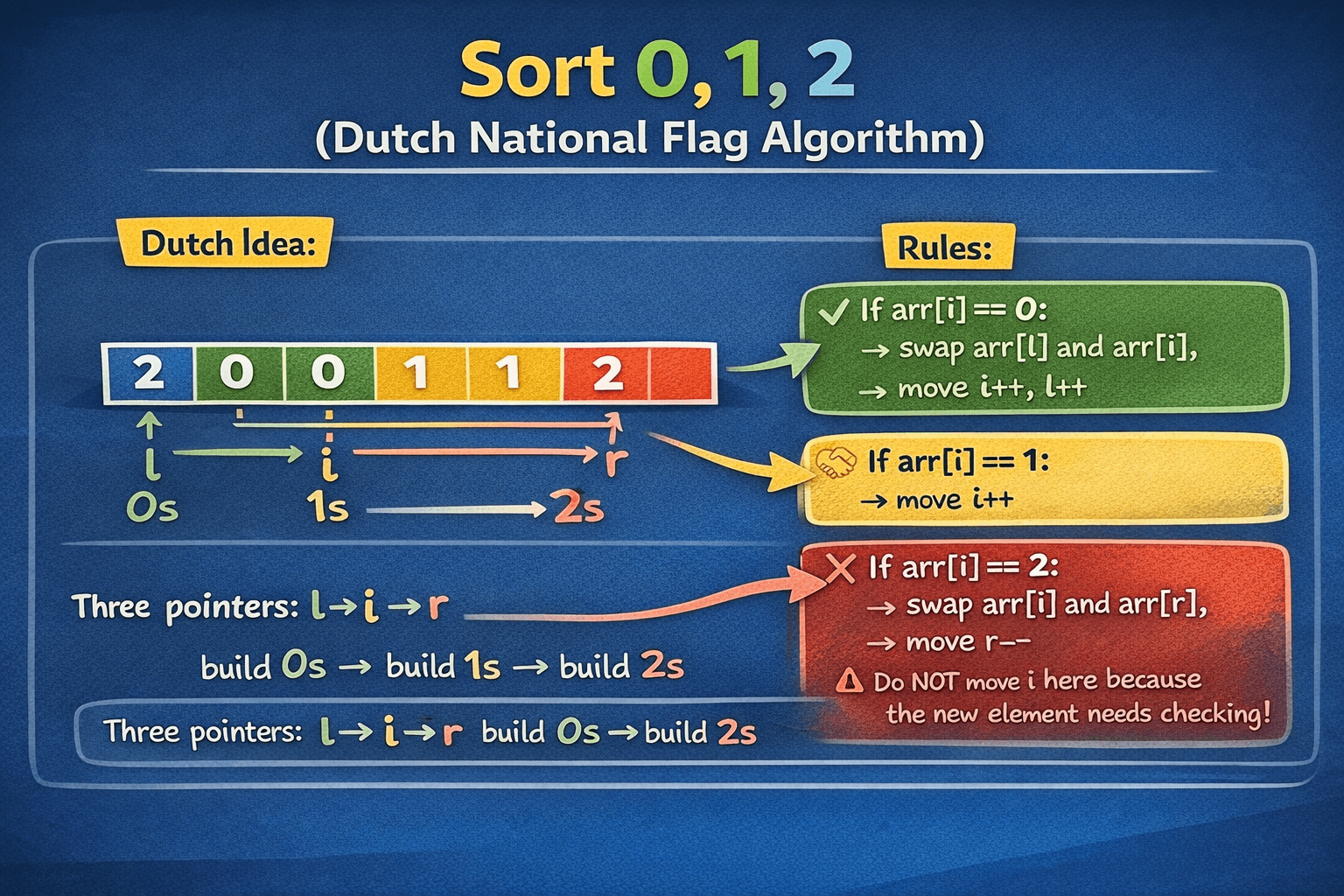
Approach 2: Dutch National Flag (One Pass)
Now comes the real interview approach
Idea
Use two pointers:
l→ starti→ startr→ end
Rule:
If
arr[i] == 0→ swaparr[i]with arr[l] , then movei++,l++if
arr[i] == 1-> movei++If
arr[i] == 2→ swaparr[i]witharr[r], thenr--
Step-by-Step Dry Run
Input:
[2, 0, 2, 1, 1, 0]
Initial
[2, 0, 2, 1, 1, 0]
 l
 i
                r
Step 1 :
arr[i] = 2
swap with arr[r]
Only r--, Don’t move i
[0, 0, 2, 1, 1, 2]
 l
 i
             r
Step 2 :
arr[i] = 0
→ swap with arr[l]
Move both:
l++, i++
[0, 0, 2, 1, 1, 2]
    l
    i
             r
Step 3 :
arr[i] = 0
→ swap with arr[l]
Move:
l++, i++
[0, 0, 2, 1, 1, 2]
       l
       i
             r
Step 4 :
arr[i] = 2
→ swap with arr[r]
Only:
r--
[0, 0, 1, 1, 2, 2]
       l
       i
          r
Step 5 :
arr[i] = 1
Just:
i++
[0, 0, 1, 1, 2, 2]
       l
          i
          r
Step 6 :
arr[i] = 1
→ move forward
i++
[0, 0, 1, 1, 2, 2]
       l
             i
          r
Done
i > r → stop
Final Output
[0, 0, 1, 1, 2, 2]
Key Rules (Remember This)
If arr[i] == 0
swap(arr[l], arr[i]);
l++;
i++;
If arr[i] == 1
i++;
If arr[i] == 2
swap(arr[i], arr[r]);
r--;
Code
int i = 0;
int l = 0;
int r = n - 1;

while(i <= r){
    if(arr[i] == 0){
        swap(arr[l], arr[i]);
        l++;
        i++;
    }
    else if(arr[i] == 1){
        i++;
    }
    else{
        swap(arr[i], arr[r]);
        r--;
    }
}
Complexity
Time: O(n) (single pass)
Space: O(1)
Final Thoughts
If you understood this problem:
You now understand:
Two pointer technique
In-place partitioning